
This article gives an overview of ocean alkalinity enhancement (OAE), how to simulate OAE deployment scenarios in the En-ROADS Climate Solutions Simulator, and the impact of OAE on greenhouse gas emissions and the climate. Watch the video below for a summary.
TABLE OF CONTENTS
- Ocean alkalinity enhancement: An experimental approach to marine carbon removal
- Simulating OAE using En-ROADS
- Potential outcomes and big messages
- Co-benefits, equity considerations, and concerns
- Acknowledgements and funding
Ocean alkalinity enhancement: An experimental approach to marine carbon removal
Ocean alkalinity enhancement (OAE) is one of many potential methods of marine carbon dioxide removal that aim to durably sequester atmospheric carbon dioxide in the ocean. OAE encompasses a suite of technologies that add alkaline materials, either derived from alkaline rocks or produced electrochemically from seawater, to the water to increase its capacity to absorb carbon dioxide from the atmosphere and store it in the ocean as bicarbonate. OAE is in the research, development, and demonstration phases, with a few field trials underway. Both mineral-based and electrochemical methods of OAE can be simulated in En-ROADS.
What is alkalinity?
Alkalinity measures water’s capacity to neutralize acid; it is the ocean’s natural buffer. Seawater is naturally alkaline because dissolved minerals, primarily bicarbonate (HCO₃⁻) and carbonate (CO₃²⁻) ions released by the weathering of rocks over millions of years, can neutralize acid. A higher alkalinity allows the ocean to absorb more CO₂ from the atmosphere.
How OAE works
Billions of tons of carbon dioxide are exchanged between the atmosphere and oceans annually. This exchange of carbon dioxide between air and sea is driven by the difference in CO₂ concentrations between the two systems in order to reach equilibrium. As human activities have driven up the CO₂ concentration in the atmosphere, the natural equilibrium has been disrupted, resulting in a greater net flow of CO₂ into oceans. The ocean acts as a “carbon sink” and has already absorbed about 30% of the CO₂ that has been emitted due to human activities. This has significant benefits for the climate, but it comes at a cost: the more CO₂ the ocean absorbs, the more acidic it becomes.
When CO₂ dissolves in seawater, it undergoes chemical reactions that produce acid. As the ocean absorbs more CO₂ from human activities, this steadily lowers its pH, a trend called ocean acidification. As a result, the ocean today is approximately 30% more acidic than in pre-industrial times and is continuing to acidify. The “Ocean Acidification” graph in En-ROADS shows this relationship directly: as atmospheric CO₂ concentration rises, ocean pH falls (acidity increases).
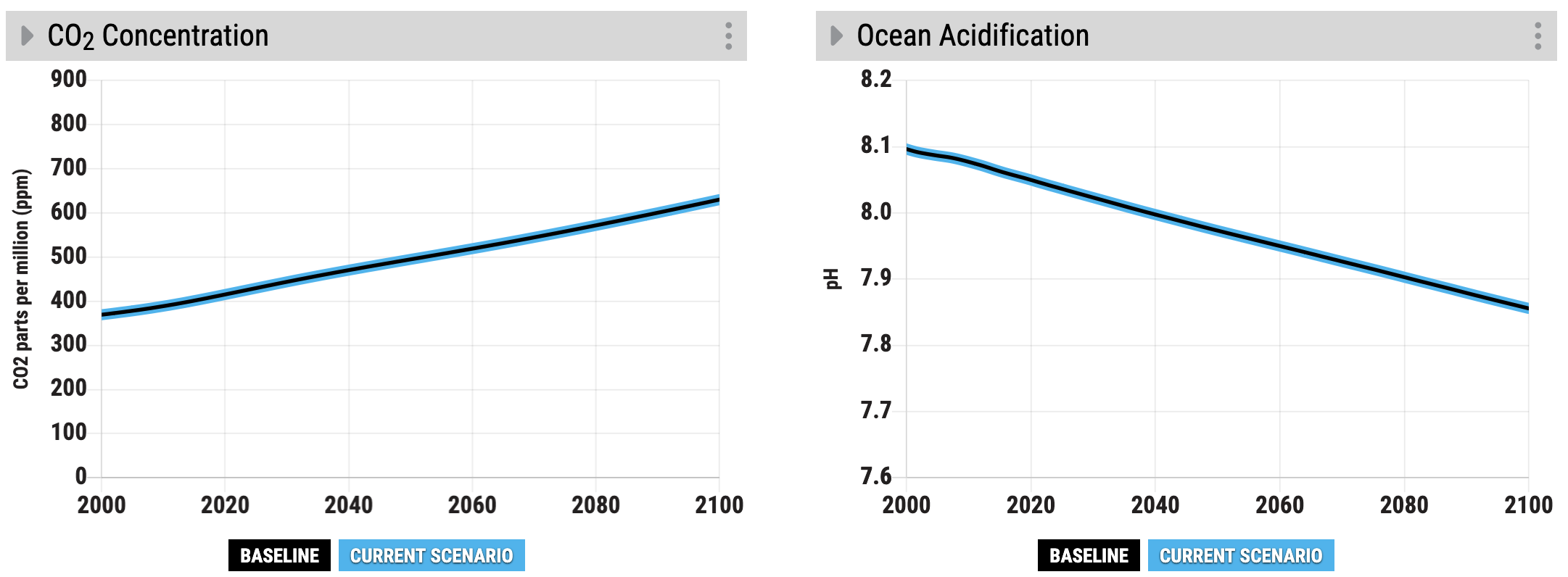
Ocean acidification in the En-ROADS Baseline Scenario, without any OAE deployment.
Ocean alkalinity enhancement works in the opposite direction of ocean acidification. Adding alkaline material to seawater raises its pH, making it less acidic. This creates a driving force that pulls additional CO₂ from the atmosphere into the ocean. Once that extra CO₂ enters seawater, it reacts with the extra alkalinity to form bicarbonate, which is stable in the ocean for tens to hundreds of thousands of years.
Researchers are exploring several OAE approaches. En-ROADS models two of them: mineral-based OAE and electrochemical OAE. These methods are combined in the “Ocean alkalinity enhancement (OAE) price” slider in En-ROADS, but the mixture of methods can be adjusted in the Assumptions.
Mineral-based OAE
Mineral-based OAE is similar in principle to enhanced mineralization, another form of technological carbon removal in En-ROADS. Mineral-based OAE involves spreading alkaline minerals on the ocean’s surface, where they dissolve and increase ocean alkalinity. Learn more about mineral-based OAE in the explainer from Ocean Visions.
Electrochemical OAE
Electrochemical OAE uses electricity to manipulate the chemistry of seawater, separating it into acidic and basic, or alkaline, components. The basic component (such as sodium hydroxide, NaOH) can be returned to the ocean, where it would enhance ocean alkalinity and react with dissolved CO₂ to form stable bicarbonate ions and draw additional CO₂ in from the atmosphere. The acidic component could be used to strip CO₂ directly from seawater or to dissolve alkaline minerals. These systems could potentially be deployed at existing coastal facilities such as desalination plants, wastewater facilities, or aboard ships. Learn more about electrochemical OAE in the explainer from Ocean Visions.
Simulating OAE using En-ROADS
Introducing a revenue source for OAE
Like other experimental methods of technological carbon dioxide removal, the En-ROADS Baseline Scenario assumes no significant funding of OAE and therefore no significant deployment of the technology into the future. To simulate funding and deployment of OAE, use the main “Technological Carbon Removal” slider (which induces direct air capture, OAE, and enhanced mineralization) or the specific “Ocean alkalinity enhancement (OAE) price” slider within its advanced settings.

This slider reflects the price that buyers would be willing to pay for a ton of carbon dioxide removal (CDR) delivered by OAE.
The “Sources of Anthropogenic CO₂ Removals” and “Cumulative Anthropogenic CO₂ Removed by Source” graphs show the net amount of CO₂ removed by this method:
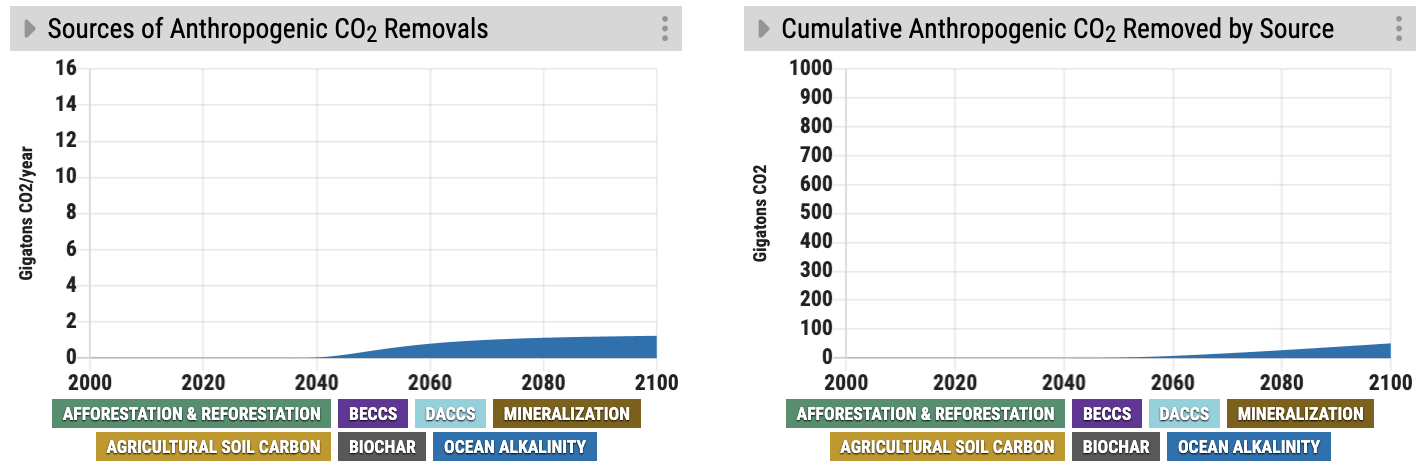
Energy requirements and net removals
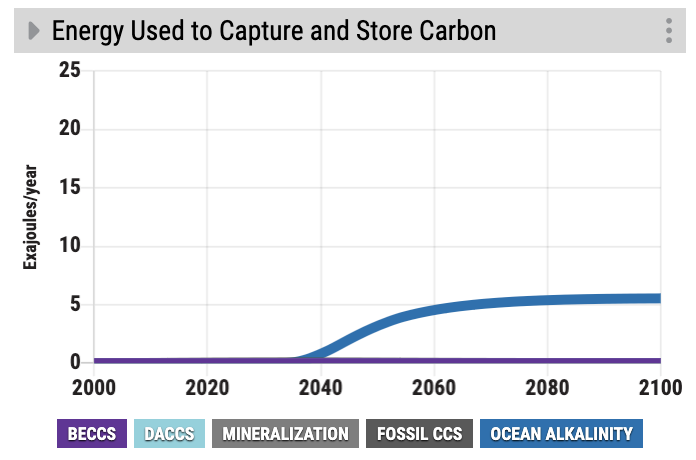
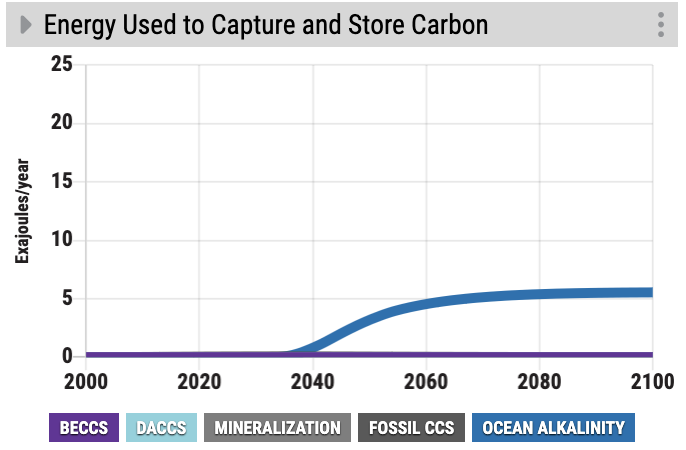
Both mineral-based and electrochemical OAE require energy, shown together in the “Energy Used to Capture and Store Carbon” graph. Mineral-based OAE requires energy to mine, grind, transport, and spread the alkaline minerals in the ocean, and electrochemical OAE requires energy to operate the electrochemical equipment and move raw materials and products. Energy intensity falls as the technology matures, but thermodynamics sets a bound on the minimum energy required, regardless of how efficient the process becomes.
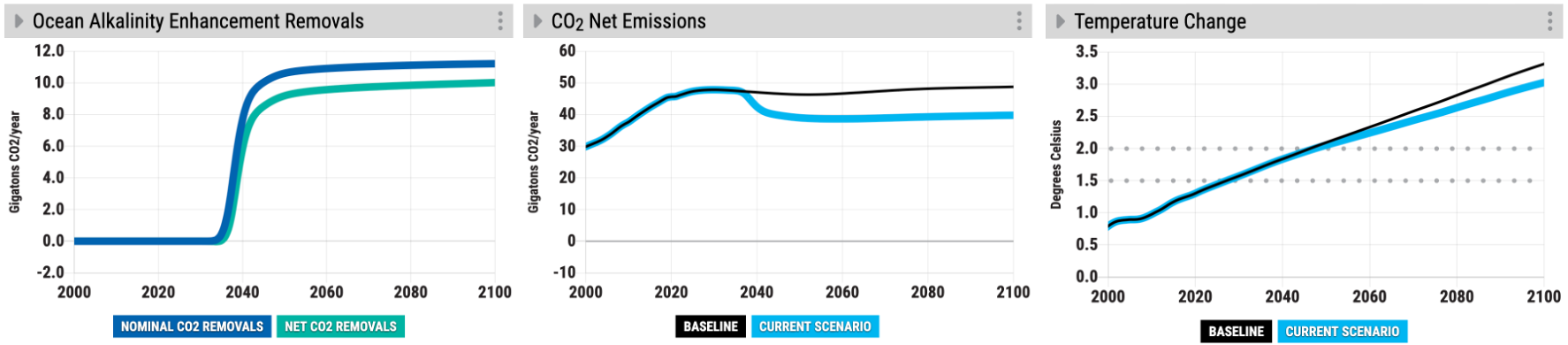
The energy used by OAE carries its own carbon cost. Net removals—the true climate benefit—equal nominal removals minus the CO₂ emitted to power OAE operations (assumed to have the carbon intensity of final electric energy). The “Ocean Alkalinity Enhancement Removals” graph shows both: nominal CO₂ removals in blue and net CO₂ removals in green.
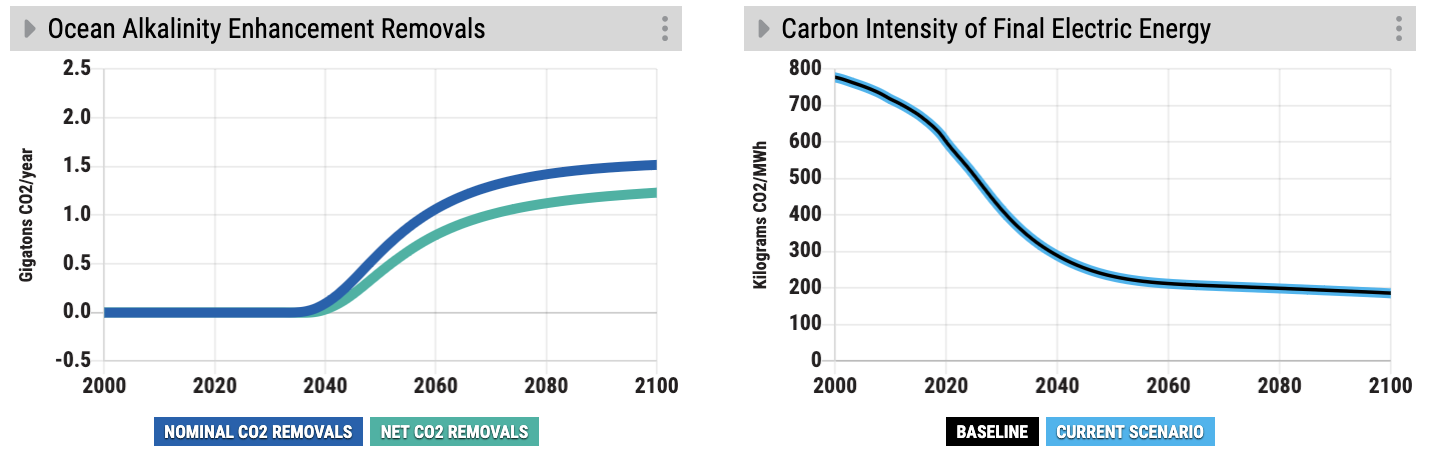
Due to the CO₂ emissions from energy, net CO₂ removals are lower than nominal removals.
Details about the modeling of ocean alkalinity enhancement in En-ROADS are available in the En-ROADS Technical Reference.
Uncertainties, dynamics, and limitations
Explore different factors that affect the growth, limitations, and timing of OAE using graphs and the “Ocean alkalinity enhancement” section of the Assumptions, located under “Simulation” in the top menu bar. See the graph and slider descriptions in En-ROADS for more information.
- Method of OAE: Moving the “Ocean alkalinity enhancement (OAE) price” slider or the main Technological Carbon Removal slider funds both mineral-based and electrochemical OAE under the default assumption settings. This mix can be adjusted using the “Percent electrochemical (vs. mineral) OAE” slider in the Assumptions. The slider’s default setting of 30% means that 30% of the funding goes towards electrochemical OAE and 70% of the funding goes towards mineral-based OAE. To simulate only mineral-based OAE, move this Assumptions slider to 0%; to simulate only electrochemical OAE, move it to 100%.

Example: At 0%, only mineral-based OAE is funded.
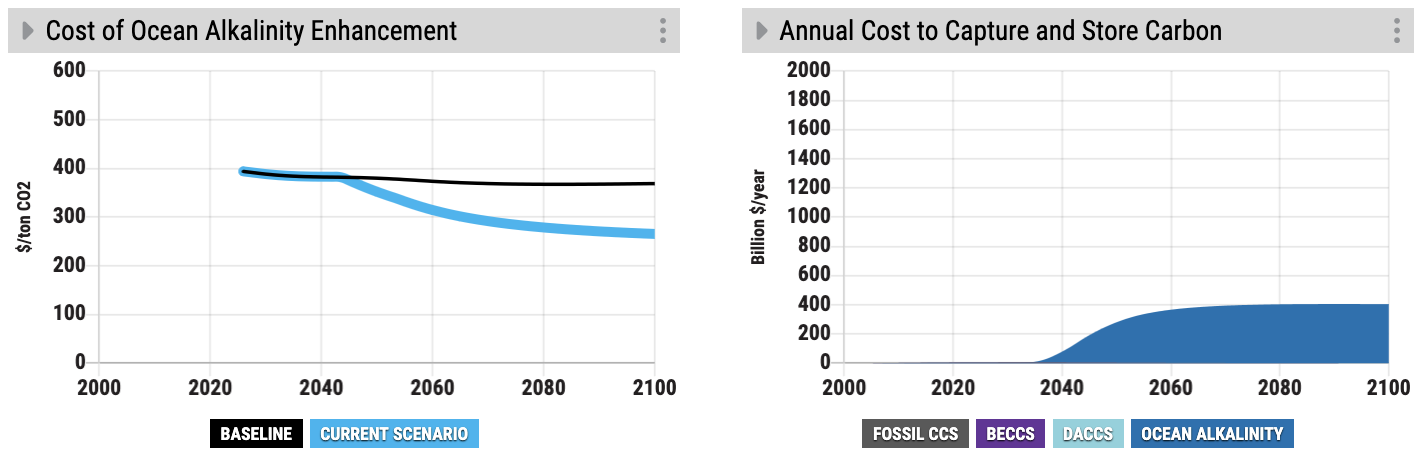
- Cost: When an OAE revenue source is introduced, the average cost per ton of CO₂ removed initially rises slightly as OAE’s demand for energy pushes up energy prices, and then falls as experience accumulates and economies of scale take hold. View the “Cost of Ocean Alkalinity Enhancement” and “Annual Cost to Capture and Store Carbon” graphs for an overall look at the average cost to sequester a ton of CO₂ through OAE and the total amount of money spent on this technique. The factors that influence these costs can be adjusted using the following Assumption sliders:
- Initial cost of OAE (excluding energy)
- Progress ratio (OAE)
- Electrochemical OAE energy intensity
- Mineral OAE material energy intensity
- Mineral OAE absorption ratio
- Energy: In addition to the energy impact on costs, users can view the relative scale of energy required to sequester carbon via OAE. In this scenario, OAE capturing 1.2 Gt CO₂ per year in 2100 requires about 5 EJ of energy, roughly equivalent to half of today's entire global nuclear energy consumption. See the “Nuclear Final Consumption” graph for a comparison.
 The factors that influence energy intensity can be adjusted using the following Assumptions sliders:
- Progress ratio (OAE)
- Electrochemical OAE energy intensity
- Mineral OAE material energy intensity
- Mineral OAE absorption ratio
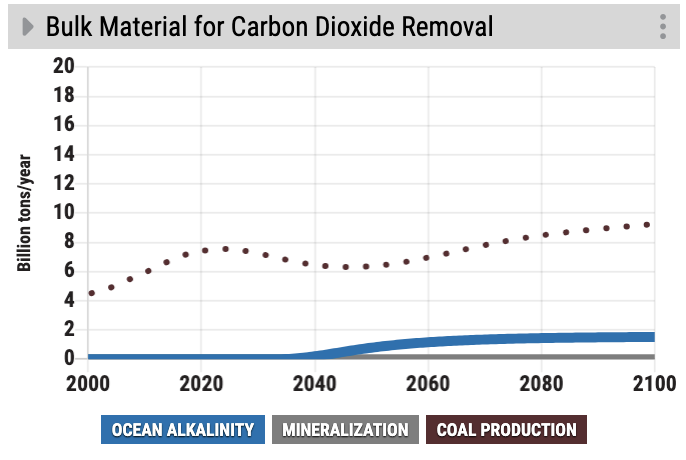
- Material needed: Mineral-based OAE requires sourcing and moving large volumes of material. The “Bulk Material for Carbon Dioxide Removal” graph shows how the material required for OAE compares to other CDR methods and to global coal production for a sense of scale. The “Mineral OAE absorption ratio” Assumptions slider adjusts the amount of rock required to remove a ton of CO₂.
- Market size and community support: OAE is a rapidly emerging CDR pathway with significant uncertainty in its growth trajectory, funding, and limiting factors. Because a robust global market for OAE does not yet exist and data on willingness-to-pay is limited, users can test a range of supply assumptions with the “OAE market at cost parity” Assumptions slider. Similarly, the “OAE scale before constraints increase costs” slider represents the point at which factors such as community resistance, limited coastal access, and other barriers begin to slow deployment, reflected in rising costs. For more on community acceptance, see the equity section below.

- Efficiency: En-ROADS models OAE at a global level. In practice, the efficiency and speed of OAE vary by region, season, and ocean circulation. If ocean currents move added alkalinity away from the surface quickly, less CO₂ is drawn from the atmosphere. The “Time for CDR response to OAE” in the Assumptions sets how long ocean alkalinity additions take to achieve most (99%) of their effect on the global carbon cycle.
- Timing: Two sliders control the timing of OAE deployment: “OAE price start year” (under Technological Carbon Removal advanced settings) sets when revenue sources begin, and “OAE infrastructure completion time” in the Assumptions controls how long it takes to build OAE infrastructure.
Potential outcomes and big messages
Deploying OAE at scale would reduce atmospheric carbon dioxide (CO₂) concentration with a potential co-benefit of buffering ocean acidification in specific areas where it is deployed. However, by itself, OAE is not powerful enough to significantly reduce warming. Carbon dioxide removal by methods such as OAE must be combined with deep reductions in fossil fuel emissions in order to substantially address climate change.How much does OAE contribute to climate mitigation?
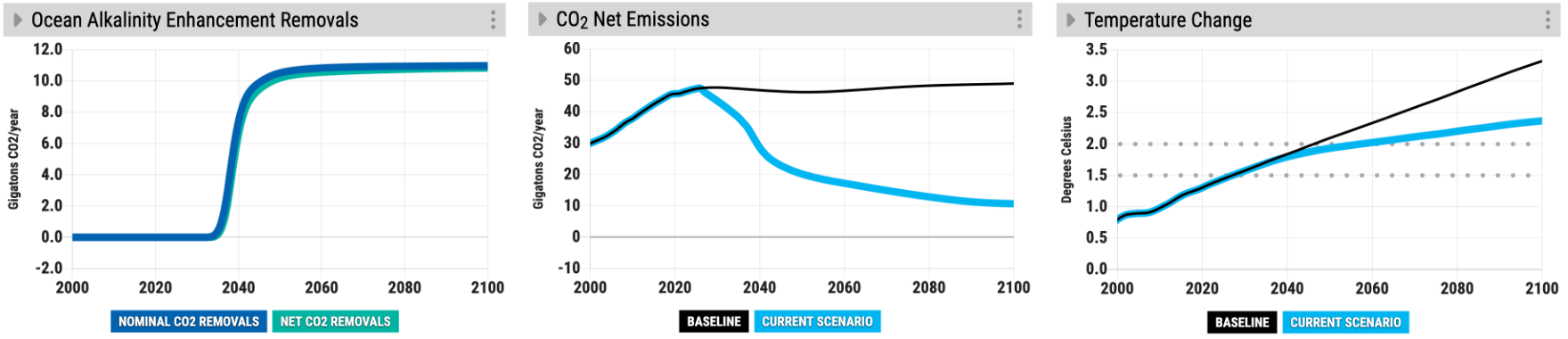
The “Ocean Alkalinity Enhancement Removals,” “CO₂ Net Emissions,” and “Temperature Change” graphs show the results of the OAE scenario. The climate impact depends on how much OAE is deployed and on overall CO₂ emissions. A scenario with a high level of OAE deployment (driven by robust revenue sources and favorable conditions), but no additional climate action, results in 10 gigatons per year of CO₂ removal and about 0.3°C of temperature reduction by 2100:
When OAE deployment is combined with an energy system with less fossil fuel, as in this scenario that adds a $200/ton CO₂ carbon price, the result is net CO₂ removals closer to nominal CO₂ removals and nearly a gigaton more of CO₂ removed per year by 2100. Due to the combination of a substantial carbon price with OAE, the temperature reduction by 2100 is 0.9°C compared to the Baseline Scenario.
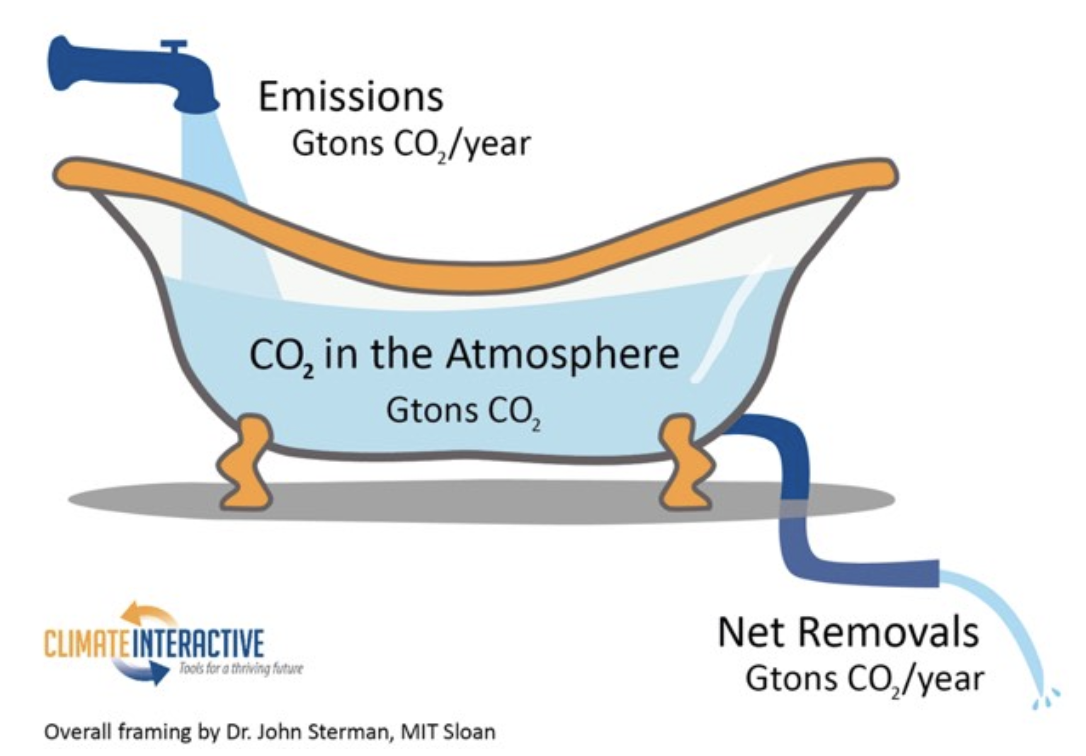
By itself, OAE will likely not substantially reduce warming; doing so would require deep cuts to emissions alongside any scale-up of OAE or other CDR methods. As long as more CO₂ is added to the atmosphere than is removed from it, temperature keeps rising. Warming only starts to reverse once emissions turn net negative, meaning emissions reductions have brought total emissions below the amount being removed by CDR methods like OAE. A useful way to think about this is the bathtub analogy.
Net removals depend on low-carbon energy for OAE
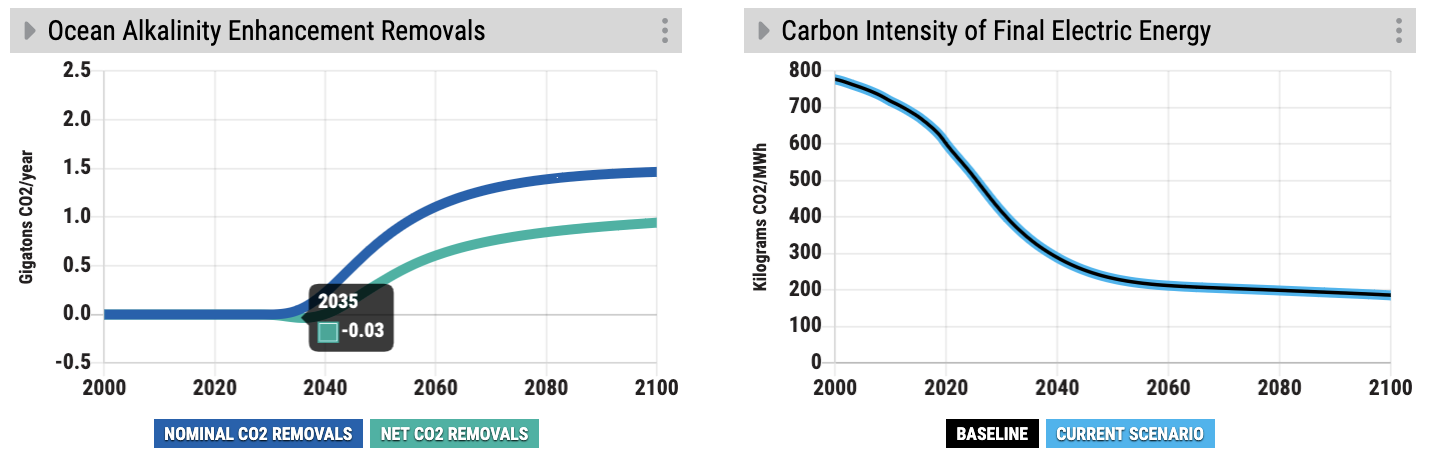
Early in deployment, if the electrical grid is still carbon-intensive and before the added alkalinity has time to remove CO₂ from the atmosphere, net removals can turn negative, meaning OAE emits more CO₂ than it removes. The graphs below show OAE deployment in a scenario with more pessimistic assumptions about the energy intensity of OAE, requiring OAE to use more energy while carbon intensity of electricity (shown in the “Carbon Intensity of Final Electric Energy” graph) is still high. As a result, net removals around 2035 are negative, meaning that emissions from OAE are higher than removals:
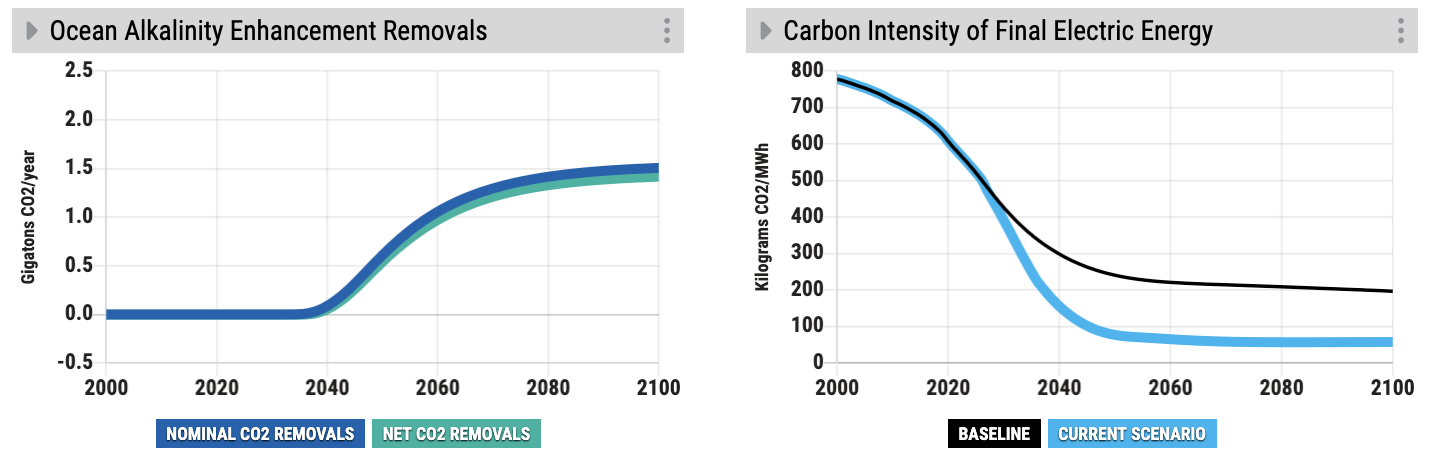
This is why a cleaner energy system makes OAE significantly more effective. En-ROADS assumes that the energy used for OAE has the carbon intensity of the electrical grid mix, so reducing the carbon intensity of that electricity directly increases OAE's net climate benefit. In scenarios that phase down fossil fuels and expand renewables, like in this one, net removals approach nominal removals, and OAE contributes meaningfully more to reducing warming:
Co-benefits, equity considerations, and concerns
OAE offers meaningful co-benefits, but like other experimental carbon removal technologies, it also carries potential risks, some of which remain to be fully understood.
Co-benefits
Buffering ocean acidification
A potential co-benefit of deploying OAE is reducing ocean acidification. By affecting ocean chemistry directly, OAE would have a greater impact on ocean acidification than the same amount of removals from another CDR method like direct air carbon capture and storage (DACCS). While the changes are negligible on the global scale, in local areas this could have a meaningful impact on ocean-dwelling organisms, especially those that form shells. Around fisheries, key marine habitats, and coral reefs, this could help counteract the effects of ocean acidification and improve ecosystem health.
Concerns and equity considerations
Like other experimental carbon removal technologies, OAE presents possible negative effects and potential unknowns, which is one reason why research groups are conducting field trials to gather more data before large-scale deployment can be assessed. Concerns include:
- Ecological impact uncertainty. The effects of large-scale alkalinity addition on ocean ecosystems are unknown and being investigated.
- Mineral feedstock contaminants. Rocks or industrial byproducts used for mineral-based OAE could contain trace heavy metals, which might introduce contaminants into coastal waters.
- Increased turbidity. Spreading ground alkaline minerals into the ocean adds fine particles to the water, which can increase turbidity (cloudiness) near deployment sites. This could reduce light available to photosynthetic organisms, such as phytoplankton and seagrass, and affect filter-feeding species.
- Mining could impact nearby communities. Mining and transport of minerals for OAE could bring both benefits (in the form of jobs) and negative impacts to nearby communities (in environmental degradation, noise, air pollution, competition for coastal space with fishing and other marine industries, and impact on water resources).
- Electrochemical OAE waste. The byproducts (weak, salty acid) of electrochemical OAE could require careful management, and disposing of them could have environmental implications.
Resources
Acknowledgements and funding
Climate Interactive developed the OAE feature in En-ROADS in partnership with Ocean Visions. Ocean Visions provided funding, reviewed the scientific representation of ocean chemistry, and connected the team with the subject matter experts whose feedback informed the modeling.