
Read the explainer about Ocean Alkalinity Enhancement (OAE) in En-ROADS for an introduction to OAE and how to use it in En-ROADS. The FAQs below cover common questions about the technology and how it's modeled in En-ROADS.
1. How long does the carbon removed and stored by OAE stay sequestered?
OAE sequesters atmospheric CO2 by holding that carbon as dissolved bicarbonates in seawater (the end result of reacting CO2 in seawater with alkaline materials). Bicarbonates in the ocean are durably stored for tens to hundreds of thousands of years. Therefore in En-ROADS, carbon sequestered by OAE doesn’t have an assumption about leakage (unlike geological storage by DACCS), as it is assumed to stay locked up in carbonates and bicarbonates indefinitely. Learn more about how En-ROADS models ocean alkalinity in the En-ROADS Technical Reference.
2.How do I simulate only mineral-based OAE? How do I simulate only electrochemical OAE?
The default settings for the relative percentages of OAE pathways in En-ROADS are 30% electrochemical OAE and 70% mineral-based OAE. This split is an input chosen by the user in the Assumptions and not driven by relative costs, limitations, or market factors. To simulate mineral-based OAE only, move the “Percent electrochemical (vs. mineral) OAE” Assumptions slider (under Simulation > Assumptions > Ocean alkalinity enhancement (OAE)) to 0%. To simulate electrochemical OAE only, move this slider to 100%.
3. How do I model public opposition to OAE?
Introducing and scaling OAE may result in pushback from local environmental conservation groups, coastal industry interests, and others. There is no single metric that can capture this kind of complex pushback. In En-ROADS, we represent this public opposition as a threshold of OAE deployment where costs begin to increase. The lower the threshold, the higher the simulated pushback. Adjust the “OAE scale before constraints increase costs” Assumptions slider (under Simulation > Assumptions > Ocean alkalinity enhancement (OAE)). This slider captures effects, such as public opposition and prospective site limitations, that arise as the industry scales up.
4. Why can net OAE removals be negative?
The “Net CO2 removals” line on the “Ocean Alkalinity Enhancement Removals” graph can be negative (meaning that more CO2 is emitted by this process than is removed) due to several factors:
- CO2 emissions from fossil fuels: If OAE deployment uses the carbon-intensive energy mix in the En-ROADS Baseline Scenario, emissions from that energy can exceed removals early on, especially since there's a delay between deployment and when removals actually occur. See this scenario. To avoid this, change the energy mix through discouraging fossil fuels, implementing a carbon price, and/or encouraging renewables.
- Delays in the carbon cycle: Net CO2 removals can also stay negative longer if the time for OAE to take effect on the carbon cycle is long. This can be adjusted using the “Time for CDR response to OAE” slider in the Assumptions.
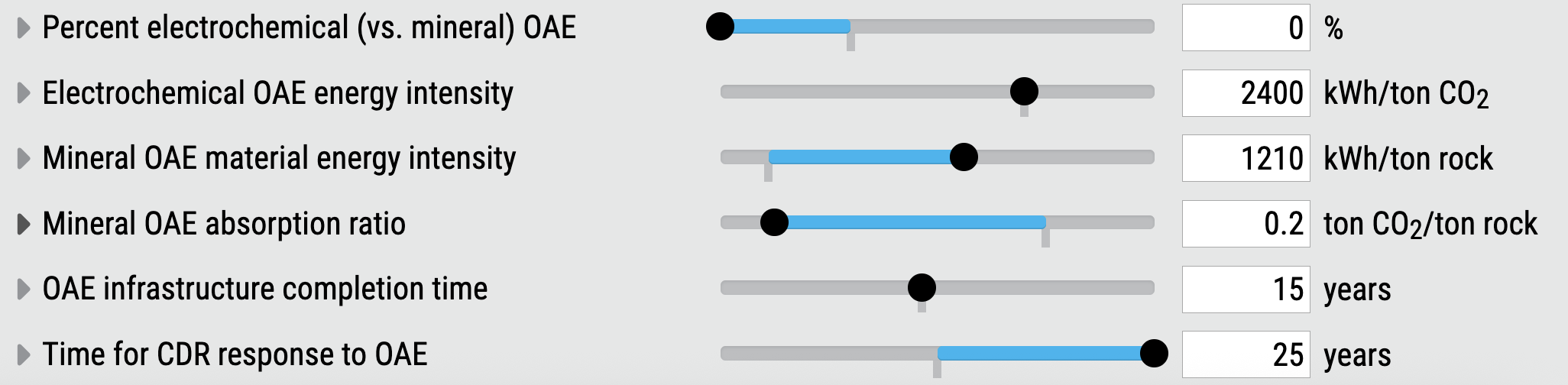
- High inefficiency: If the process is significantly inefficient, net removals may never turn positive (at least not before 2100, the extent of the En-ROADS simulation), meaning OAE deployment would be actively worse for the climate than not deploying it at all. See this scenario, which changes the default OAE assumptions to reflect the extreme range of inefficiency in OAE conditions:
5. If the cost of OAE is less than the funding available, why doesn't that extra funding drive the cost down further? For example if OAE costs $250/ton CO2, and the funding is $1000/ton CO2?
Because price (funding) and cost are different things. The “Ocean alkalinity enhancement (OAE) price” slider under the Technological Carbon Removal section sets the revenue available to OAE providers (what someone is willing to pay per ton of CO2 removed), not the underlying cost of producing those removals. A higher price doesn't make OAE cheaper to do; it just makes more of it financially viable. Where deployment costs are below the funding level, projects are more able to proceed; where costs exceed it, they are less able to.
The cost is a global average, so even if funding is below the cost, some projects proceed and you will see some removals from OAE, e.g. in this scenario. The cost curve itself falls only through learning and economies of scale, not through higher subsidies. More funding expands how much OAE gets deployed, but it doesn't change how much OAE actually costs.
6. Does it matter where in the ocean OAE is deployed?
Yes. Research indicates certain ocean regions offer higher removal rates per unit of mineral-based alkalinity added. In addition, proximity to the source of minerals is an important factor for financial feasibility and transport energy requirements. For electrochemical approaches, proximity to clean energy is a key siting consideration that affects net carbon removal.
7. Does En-ROADS simulate additional emissions from ships (fuel) for deploying mineral-based OAE?
En-ROADS doesn’t model ship emissions (or sulfur particulate matter from shipping) specifically. It models energy use overall, using electricity as a proxy for all OAE-related energy. That's a reasonable proxy because the majority of OAE energy use is for grinding rock. The exact share depends on processing method, particle size, and other factors, but the median value is about 90% of energy going to grinding (Foteinis, S., et al., 2023).